
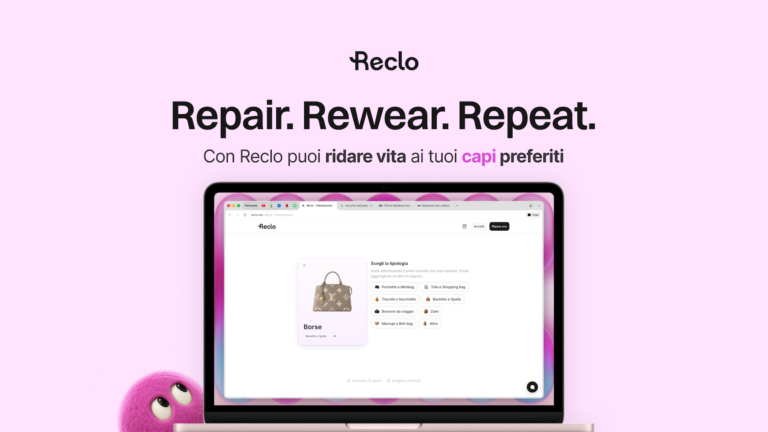
Milan, November 19, 2026—Reclo is an Italian start-up, a digital platform meant to make repairing shoes, bags, and clothing easy, affordable, and transparent through a network of artisans across the country.
Repairing damaged clothes and accessories takes just a few clicks, from requesting a quote to pickup and home delivery and requires from ten to 14 days to have an item repaired and sent back to its owner.
The platform grew out of the difficulty of getting an item repaired. When a product breaks, you have to find the right artisan, figure out what work it needs, get a quote, arrange delivery, and manage pickup. Sometimes it’s easier to just throw the item away and buy a new one.
Reclò aims to turn this dynamic on its head. To that end, it has built a digital infrastructure that connects customers, brands, and specialized artisans.
At the heart of the model is a network of artisans and workshops across Italy. The platform links the demand for repairs with artisanal skills that are often fragmented and hard to access.
Duccio Travaglini, Matteo Speranza, and Filippo Travaglini founded Reclò. The three young entrepreneurs bring complementary skills to the table. Duccio Travaglini founded Greencome Media, a vertical new media outlet focused on environmental sustainability, with a community of over 300,000 people. The other two partners have also contributed to the project over the years. Working together there led them to found Reclò and gave them expertise in building and scaling digital projects related to sustainability.

With Reclo, the three founders aim to bring their experience to the fashion industry, with the goal of building an infrastructure that makes repair cool, accessible, and scalable.
Reclo has also developed a B2B solution for brands and retailers. With it, fashion companies can integrate care and repair services into their customer experience, using Reclò’s infrastructure.
Repair is returning to the forefront of consumer habits. According to Italian broadcaster Sky, demand for repairs in Italy grew by up to 250% in 2025, while Google searches for “shoemaker near me” have increased by about 300% over the past five years.
This trend also fits within the European regulatory framework that textile companies will increasingly have to follow. The Ecodesign for Sustainable Products Regulation (ESPR) sets a framework for more durable and repairable products and also provides for a future Digital Product Passport for textiles. Furthermore, the ban on destroying unsold clothing and footwear has applied to large companies since July 2026.
The European Right to Repair directive complements these rules. It strengthens the role of repair in EU consumer policy and introduces specific obligations for product categories subject to repairability requirements.
At the same time, the revision of the Waste Framework Directive introduces mandatory Extended Producer Responsibility (EPR) schemes for textiles and footwear. These schemes require manufacturers to contribute to the costs of managing end-of-life products, and they encourage more durable, reusable, and repairable products.
The textile sector is thus part of a broader European trend toward making repair services more accessible and widespread.
Reclo’s proprietary platform aims to make the traditional, highly fragmented repair service scalable. One area of development is the use of artificial intelligence to support certain stages of the process, starting with collecting and interpreting information about the garment and the requested repair. In this way, AI does not replace artisanal work but makes the process more efficient.
The company behind the platform Fondazione Reclo was founded in September 2026 and already in its first month of launch recorded over 250 orders and 700 users on the platform, demonstrating strong interest in a simple, digital repair service right from the very first weeks.
It counts 45 artisans that have voluntarily reached out to collaborate with it. On the B2B front, Reclo is launching several pilot projects with fashion brands to integrate care and repair services into their customer experience.
By Maria Cristina Pavarini