
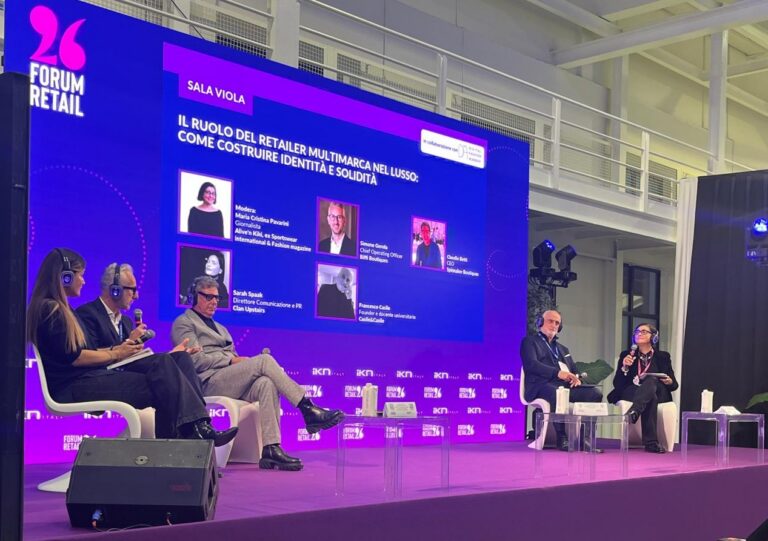
Milan, November 17, 2026—How is multi-brand retail changing in Italy? I discussed this topic during the roundtable “The Role of the Multi-Brand Retailer in Luxury: How to Build Identity and Stability” at Forum Retail 2026, an IKN Italia event in Milan.
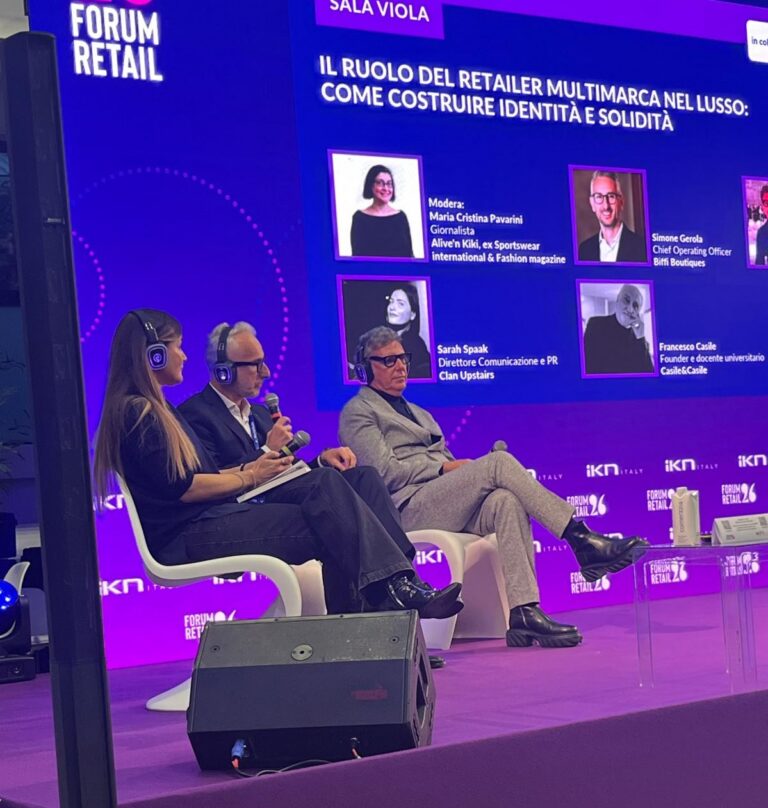
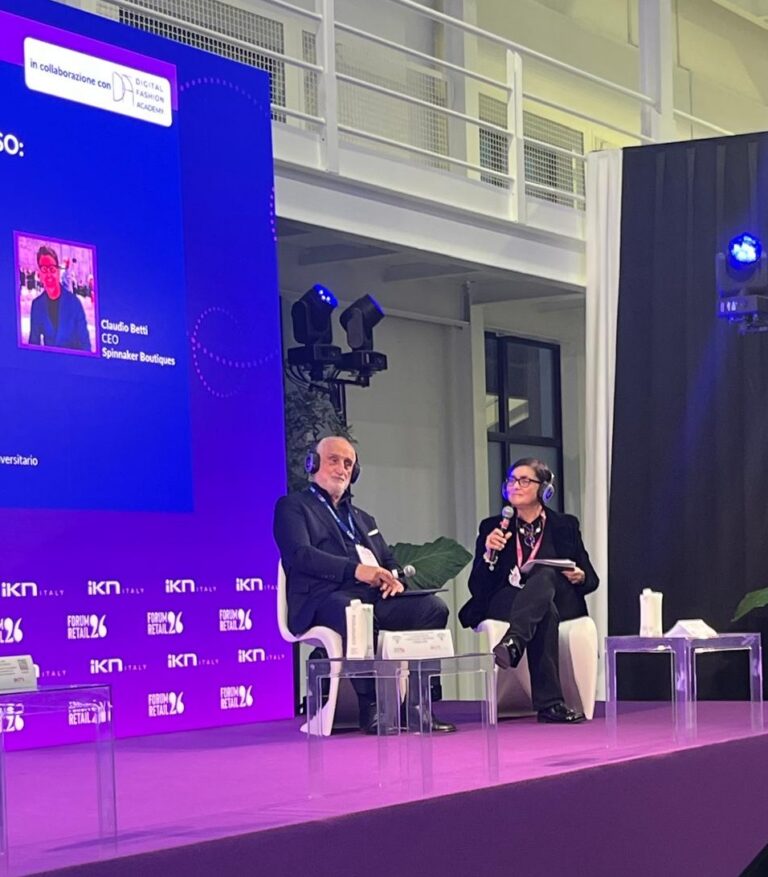
I moderated the discussion with Sarah Spaak, communication director, Clan Upstairs, Milan; Simone Gerola, chief operating officer, Biffi Boutiques in Milan and Bergamo; Claudio Betti, owner, Spinnaker Boutiques (16 stores between Liguria and Tuscany); and Francesco Casile, CEO and founder, Casile&Casile, Knight of the Order of the Republic, recipient of the 2024 Ambrogino d’Oro, global ambassador for Made in Italy, and university lecturer and instructor.
How is the retailer evolving? Retailers are no longer merely shopkeepers or agents, but true multitasking entrepreneurs who work on multiple levels—from customer engagement to the in-store experience—and have become well-rounded professionals running lifestyle events along with software houses and digital marketplaces, but also manage cultural events or hospitality projects, and engage and inform customers through newsletters, personal shopping services, and AI-generated catalogs.
Retailers must now also prepare to comply with new EPR, Green Deal, and DPP regulations and address generational succession to ensure their businesses continue.
Between experience and omnichannel
Sarah Spaak, Clan Upstairs: “We’ve been in business for 36 years, but the most significant change occurred about 10 years ago. We started out as a go-to destination for brands like Barbour, Stone Island, and C.P. Company.
Since 2016—and especially after the pandemic—we’ve revised our strategy and begun discovering new brands that have found success thanks to our store, a true ‘incubator’ that helped them take flight.
As every brand now has its own flagship stores, we had to reimagine the in-store experience, so we created a communications department. That’s how we started hosting unique experiences—from Pilates sessions to in-store dinners. Now everyone does it. That’s why we’re experimenting with new projects that combine our communications skills with our sales expertise. Our job isn’t just to rent out space.”
Claudio Betti, Spinnaker: “We’ve been in business since 1972—for over 50 years. Today we operate 16 stores from Sanremo to Alassio and Santa Margherita, including a recent acquisition in Forte dei Marmi. We have up to 80 employees during peak season.”
“We first sold through brick-and-mortar retail, then through digital channels, and now we’re seeing a slight return to brick-and-mortar. These are the two pillars of our business. They support each other, and one couldn’t survive without the other. Together they allow a more comprehensive product showcase, especially for foreign customers.”
Simone Gerola, Biffi: “We were founded 60 years ago and have since earned recognition as a ‘Bottega Storica’ (Historic Boutique). To respond to the current situation, we’re focusing on our DNA—that is, our ability to identify new trends and emerging situations and present them in our own Milanese style, as a business deeply rooted in the local community. Through our store on Corso Genova, we started exploring concepts that go beyond fashion and define our ‘Biffi State of Mind,’ collaborating with the worlds of design, art, and publishing.”
“We recently chose a theme that resonates deeply with our Milanese clientele: travel. In collaboration with WP Store, for example, we offered a series of one-of-a-kind items that serve as travel souvenirs. Our idea is to encourage customers to visit us to see what’s new. It sets us apart from everyone else—you can’t find it through digital channels.”
Making the customer feel good
Claudio Betti, Spinnaker: “Customer loyalty and service are more meaningful in person. Our DNA has its roots in the sea and has since evolved in a broader sense. We’re working to shift the focus to the customer experience by organizing events, hosting art exhibitions, and creating, for example, store windows that showcase works by local painter Mario Berrino, placing them in dialogue with what we offer in the store—even if just to encourage customers to stop by. Our goal isn’t the sale itself, but to make the customer feel good. If they feel at ease, they trust us.”
“We’re trying to go beyond the scope of a simple boutique. We plan to open a beach club and forge partnerships in the hospitality and restaurant sectors… The greatest satisfaction is seeing my customers go grocery shopping with our Spinnaker-branded tote bag. We’re part of their daily lives.”
The alliance between company, customer, and distributor
Francesco Casile, Casile&Casile: “I’ve been working in the fashion industry for 56 years and have received various recognizements, while continuing to work as a distributor for many fashion brands, including Missoni. The key to success lies in the alliance between the company, the customer, and the distributor. If one of these three links is missing, the system breaks down. At Casile&Casile, we created Casa Casile, a project that lets those who work with us visit our showroom and enjoy a family-like environment where we address sales challenges and provide support, and where they discover highly appealing and easily accessible projects and brands.”
“I believe stores must evolve from mere retail outlets into experiential centers. Physical boutiques can no longer be simple showrooms. They must offer dedicated services, cultural events, hospitality spaces, and highly personalized customer service.”
Physical or virtual? Two essential pillars, but…
Simone Gerola, Biffi: “We know we can’t afford to be absent from digital channels, because they serve as a showcase for us, but in e-commerce, if you don’t offer an experience that’s significantly different from others, it all boils down to the breadth of your product selection and price. And that’s when the price war begins—and everyone loses.”
Claudio Betti, Spinnaker: “Thanks to our online presence, our visibility has grown to the point where we’re now known internationally. However, over the years, competition has become very intense because we were pioneers. Discounts keep increasing, which has significantly reduced margins. Outlets compete with us, but physical distribution is more widespread and offers resilience through presence and service. Building customer loyalty in physical stores is easier, whereas online there’s a certain inconsistency—a customer might shop for two years and then return only a year later.”
From competitors to partners
Claudio Betti, Spinnaker: “We learned the ABC of e-commerce from Farfetch, eventually creating our own e-commerce platform and then a marketplace—THEBS.com (The Best Shops)—launched in 2023 with about 40 high-end Italian retailers. From competitors, we became colleagues and then partners in an online platform.”
Prices rising exponentially: What to do?
Claudio Betti, Spinnaker: “Our goal is to ensure our customers are satisfied and to offer them products they won’t regret buying. So we’re always careful to offer Made in Italy garments produced according to responsible standards—values we’ve never flaunted but have always considered important. We believe some luxury brands have made the wrong choices. That’s why we sometimes stop carrying them after two seasons and switch to others—perhaps smaller brands—that appeal more to consumers. As a result, our brand mix in many stores has shifted toward less luxurious and more affordable brands. However, in the most tourist-heavy areas, luxury brands play a key role in our product lineup.”
Francesco Casile, Casile&Casile: “To avoid reaching the point of no return, retailers must take action on three main operational fronts. First, they must restore the pricing structure by reintroducing accessible entry-level categories that offer high perceived value, in order to re-engage aspirational customers without devaluing the brand image.
Second, they must operate transparently to communicate real value, shifting the focus of their messaging from mere ‘logo prestige’ to supply chain traceability, craftsmanship, and raw material quality to justify the asking price.
Third, they must shift from volume to experiential value. Growth will no longer come from continuous price increases, but from long-term relationships and customer loyalty.”
How retailers stand out
Sarah Spaak, Clan Upstairs: “Today, our store serves as a showcase, with 70% of our inventory coming from our own brand—Clan Upstairs Creative Department. We produce it in Tuscany through a company we acquired, and it offers mainly staple pieces—though very distinctive ones—of the highest quality at reasonable prices.”
“No one wants to spend €5,000 on a jacket anymore. Our offer is different from what you find online, and those who leave here with a Clan suit remain a bit unique, a bit sophisticated, a bit special—all while paying reasonable prices, such as €260–€290 for a pair of pants.”
Back in the day, there were no brands, just a beautiful product
Claudio Betti, Spinnaker: “Our first store in Alassio has always been a multi-brand store. In the late ’70s and early ’80s, there weren’t yet any super-established brands. Versace and Armani existed, but they weren’t that important. My mom used to tell me that she’d go to Florence for Gucci bags, but she’d choose, for example, that year’s trendy color—blue or red—or the model with more or less capacity. Back then, brands didn’t carry the weight they would acquire in the following years. I believe we may be returning to this type of purchasing, guided by a more mature approach.
Then, once brands became more attractive, they started asking retailers to reorganize their stores to look like almost like department stores. We never did, because we wanted to keep the freedom to choose, mix, and present products the way we felt best. And we were right: many colleagues who went along with brands’ requests failed and had to return to their old format. We may be stubborn in defending our point of view, but we’re still here.”
New sustainable models
Francesco Casile, Casile&Casile: “Soon, everyone will have to comply with the new EPR laws, but no one is ready or even aware of what they need to do. Retailers will also have to make product labels clearly visible so that anyone can read the specifications right from the store window, along with the QR codes for their DPPs. Those who fail to do so will violate the law and risk expulsion from the market.”
“It is also key to introduce new circular models, such as secondhand goods and restoration. Retailers should incorporate maintenance, repair, and certified resale services to extend products’ lifespans and tap into consumers’ environmental awareness.”
By Maria Cristina Pavarini