

Ecomondo, the annual Italian trade show focused on ecological transition, circular economy, involving different industries and segments, including the textile supply chain, recently concluded its 2026 edition and is preparing to celebrate its 30th anniversary at the event scheduled for November 9–12, 2027.
The trade show held in the Rimini trade show pole brought together over 1,800 exhibitors, 21% of whom were from abroad. During the event they also hosted various roundtables discussing the key challenges involving the different industry sectors
Among other events, they hosted the talk “Inside the Making: The Power of the Process,” organized by Menabò Group, an international branding and communication agency.
The session brought together representatives from six key players in the European denim value chain—C&S, ACM, NextPrinting, Green Lab, Jeanologia, and the Menabò Group—covering, respectively, garment manufacturing, trims and accessories, finishing technologies, dyeing and washing, digital printing, and strategic branding and communications.
The event, moderated by Professor Marco Lucietti, provided an opportunity to explore the main challenges the denim and sportswear industry is now facing.
The discussion centered on topics such as the evolution of European regulations, the need to make environmental performance measurable and verifiable, and the role of collaboration among companies in developing more responsible production processes.
Despite many in the industry continuing to face this topic according to a fragmented mentality within the value chain, the discussion centered on adapting to EU regulatory shifts (including EPR, ESPR, and anti-greenwashing directives) and turning sustainability into a measurable, profitable, and authentic value proposition for partners and for the end consumer.
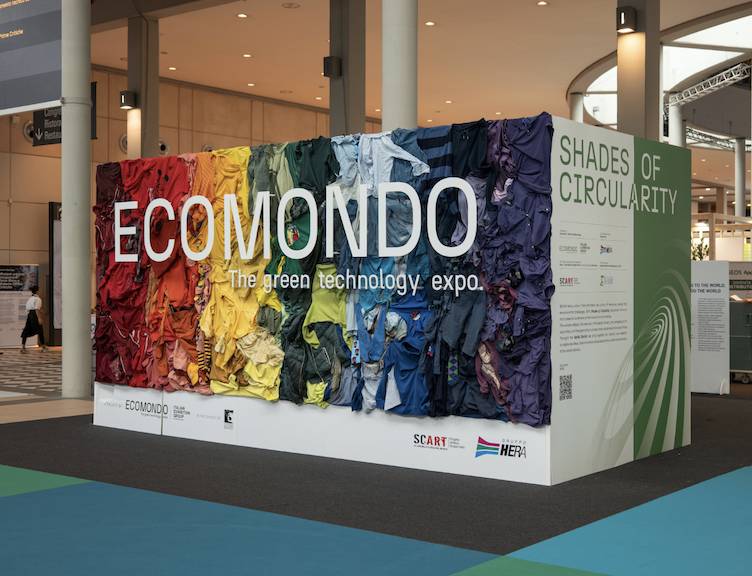
According to Professor Lucietti, denim and sportswear industry insiders still tend to see sustainability either as an added cost or as a marketing tool. “The real challenge we are addressing today is how to achieve true profitability alongside more sustainability and how ingredients and supply chain players can help brands communicate real value rather than just competing on price,” he pointed out.
Despite this, there are companies committed to taking a different, more virtuous approach. One example is C&S Jeans, an Italian high-end jeans manufacturer. “We are deeply focused on improving performance across our entire supply chain, which is why we hold numerous certifications. We work extensively with recycled materials and are preparing for the upcoming Digital Product Passport (DPP), which means opening our company doors to show with transparency how and where our garments are made,” explained Federico Corneli, CEO, C&S.
For ACM and Next Printing, a specialist in developing high-tech prints for an accessory manufacturer and a specialist in developing prints for the sportswear industry, facing new technical requests is a challenge to develop one’s creativity further and push R&D to the next level. “At ACM, continuous research is focused on combining custom engineering with sustainability,” explained Barbara Gnutti, spokesperson for ACM and NextPrinting.
“Both companies run on 100% renewable energy, recycle process water internally, and work with GRS-certified recycled materials, both in metals and leathers, to provide branding components that last throughout the garment’s lifecycle,” she added.
“With digital printing, NextPrinting prints patterns directly onto the fabric before cutting, significantly reducing energy, water, and chemical consumption. Beyond eliminating limits on creativity, this technology allows them to repurpose deadstock and leftover fabrics, turning what would otherwise be waste into high-value garments,” she pointed out.
Other companies specialized in finishing processes, such as Green Lab, have shifted a significant portion of manual and wet operations over to laser technologies. “The washing process now primarily stabilizes and refines what the machine has already marked, significantly reducing energy, water, and chemical use compared with conventional washing. It works with a reverse logic: taking out rather than adding,” explained Carlo Cossiri, partner and plant manager, Green Lab.
For Jeanologia, the commitment to minimize water use and eliminate hazardous chemicals from the process is a road they have already taken for a long time, as explained by Carmen Silla, global marketing director. “That’s what we have been doing through our MissionZero initiative,” she said. “Instead of relying on traditional, resource-intensive practices like conventional stonewashing, we use our Airwash technology. We take atmospheric air and transform it into ozone to wash and fade garments. Using air rather than water, significantly reducing water use while protecting workers’ health.”
Reaching new responsible results and becoming compliant with the new EU upcoming regulations is nothing without delivering proper information to industry insiders and the final consumer.
“New European regulations require companies to substantiate environmental claims with proven, verifiable performance in all consumer-facing communications,” explained Margherita Verlicchi, partner and brand strategist, Menabò Group.
“We study the technological innovations of the companies we support to ensure their impact is communicated accurately, knowing that data alone is not enough: reaching people always requires an authentic, empathetic, and compelling narrative,” she added
Only through a close collaboration among the different players and by delivering measurable results is a true change possible. Getting involved singly and in connection with the other is the mission every stakeholder needs to pursue now.