
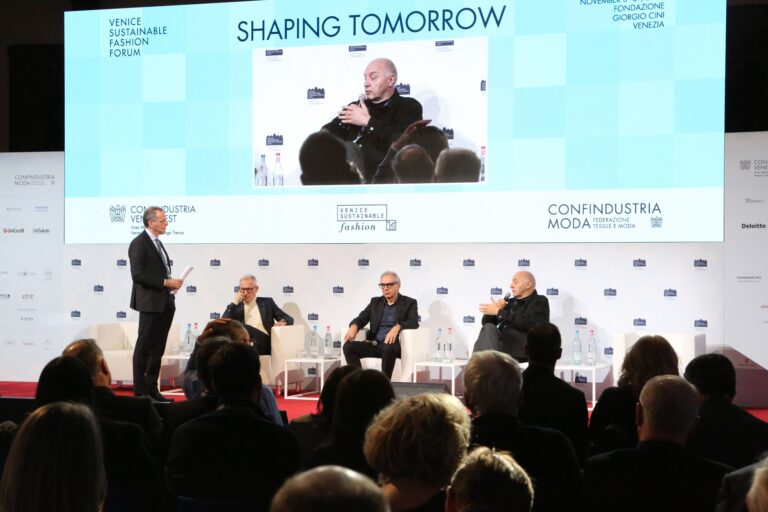
The fifth edition of the Venice Sustainable Fashion Forum, titled “Shaping Tomorrow,” took place November 5-6, 2026, at the Giorgio Cini Foundation in Venice. The conference brought together institutions and key supply chain players to shape the future of Italian and European manufacturing.
The first day focused on geopolitics, the protection of the rule of law, and human capital. The second day closed with an agenda for businesses and institutions centered on AI, the industrial-scale development of new materials, and an alliance between Italy and France to strengthen supply chains. Participants also called on policymakers to provide stable investments, clear regulations, and support for skills development.
Entrepreneurs, executives, and industry insiders attended numerous presentations. Paolo Magri, chair of the ISPI Advisory Board, analyzed the current landscape and examined how far geopolitics shapes business strategies through tariffs, new international balances, and supply security, all of which strongly influence production and commercial decisions.
For Luca Solca, managing director of luxury goods at Bernstein, market diversification, understanding shifts in demand, and stronger relationships between brands and suppliers are key to maintaining and safeguarding production capacity and corporate value.
In his presentation “Integrity is not negotiable,” Paolo Storari, a public prosecutor at the Court of Milan, addressed investigations into labor exploitation and the effectiveness of prevention and control systems. He highlighted that the Italian sector continues to produce examples of high-end brands that follow improper production practices and exploit workers [editor’s note: another case of “caporalato,” (meaning “workers’ exploitation”) involving Patrizia Pepe and Dixie, recently came to light]. Although investigators uncovered the first cases of illegal conduct in 2023, many companies still act improperly.
“The competitiveness of Italian fashion is built on our supply chains, the quality of our companies, and the skills of our people. To protect this heritage, we must give the manufacturing sector the conditions it needs to invest and innovate, strengthen collaboration between brands and suppliers, and recognize the value of labor throughout the entire production chain of ‘Bello e Ben Fatto,’ (meaning “Beautiful and Well Done”) said Luca Sburlati, president of Confindustria Moda.
“Legality is an essential and non-negotiable requirement: we need clear accountability, effective oversight, and shared tools that help companies truly manage processes at every stage. At the same time, we need consistent and certain rules, as well as a long-term industrial policy that supports companies—especially smaller ones—through the transition. From Venice, we want to build a vision for 2035 in which sustainability, innovation, and human capital become concrete investments for the future of our industry,” he added.
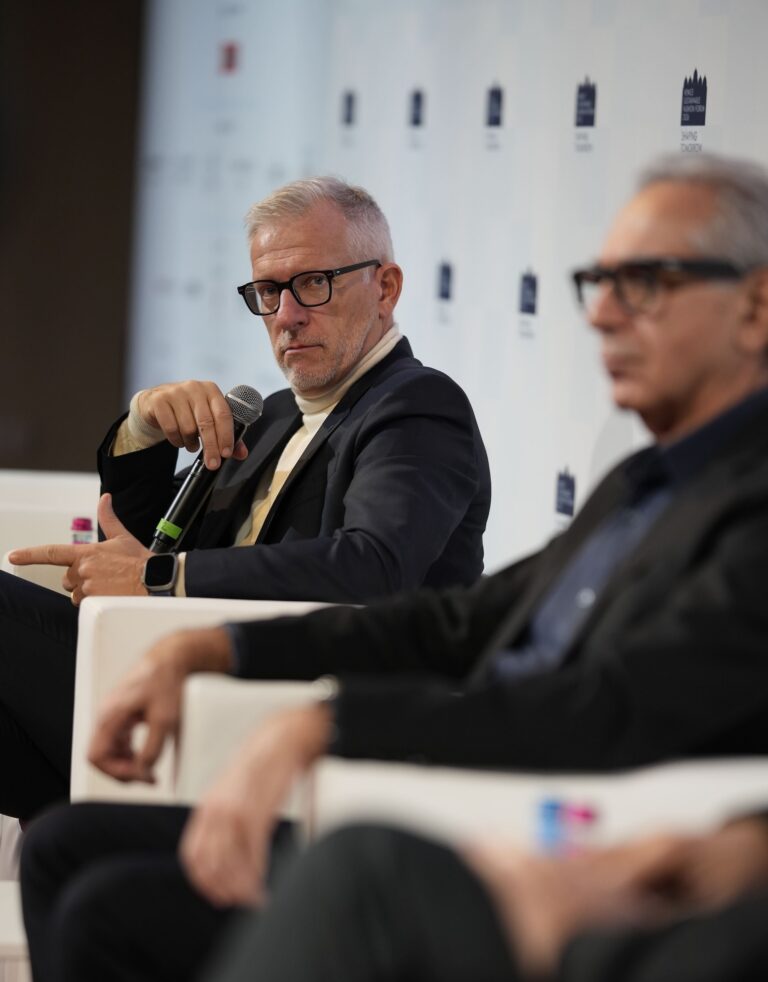
Among the final proposals, “Road to 2035” lays out an agenda with clear examples of collaboration between brands and suppliers, applied innovation, and economically sustainable circularity, along with appropriate financial incentives, the defense of legality, and skills development.
The agenda defines a National Strategic Plan for Fashion with action goals from 2026 to 2035. It calls on policymakers, institutions, and the banking system to facilitate access to resources. The study proposes pilot projects in two or three districts, with banks financing the supply chain.
Several industry players presented concrete examples of new material developments. Marcello Azzoni of Spacewear shared his experience with clothing for astronauts inside spacecraft. Simon Whitmarsh-Knight of Hyosung discussed developing bio-based spandex and the conditions needed to scale it up to industrial production. Marco Bardelle of MagnoLab presented a collaboration within the Biella supply chain that produces a combed yarn containing 50% recycled wool from pre-consumer waste.
At the European level, Carlo Capasa, president of the National Chamber of Italian Fashion; Pascal Morand, executive president of the Fédération de la Haute Couture et de la Mode; and Luca Sburlati, president of Confindustria Moda, discussed a collaborative Italy-France work plan and the signing of a Memorandum of Understanding.
“Creativity is at the heart of high-end fashion. Italy, where approximately 75% of the world’s high-end fashion production takes place, possesses an extraordinary heritage of expertise that we must protect and carry forward into the future,” said Carlo Capasa.
“Together with the Fédération de la Haute Couture et de la Mode, we have signed an important Memorandum of Understanding. We have established a voluntary ESG harmonization framework to promote shared principles, simplify compliance requirements, and support the entire supply chain,” he added.