
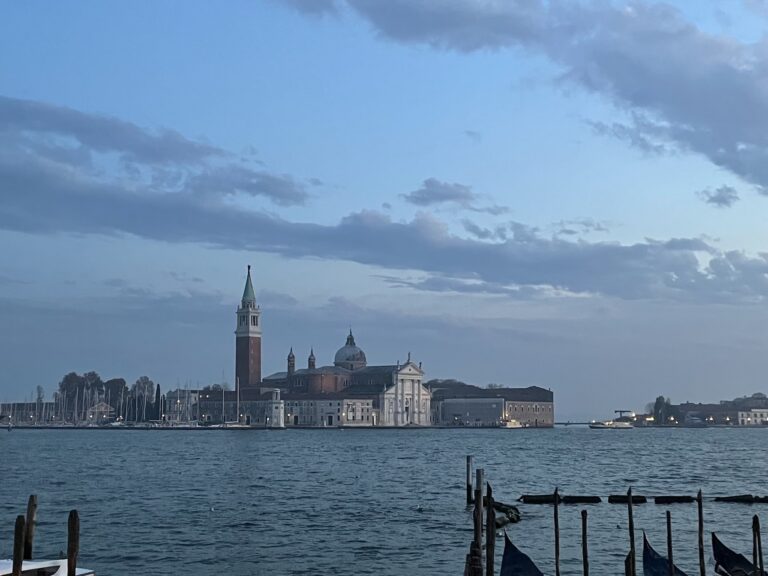
The Venice Sustainable Fashion Forum is gearing up for its fifth edition scheduled for November 5 and 6, 2026, in Venice, Italy, on the Island of San Giorgio at the Giorgio Cini Foundation.
Titled “Shaping Tomorrow,” this year’s event aims to take on a broader scope than in the past by involving Italian representatives from sectors related to fashion and accessories—such as leather goods, footwear, and eyewear—to expand its scope of analysis and integrate these supply chains into a broader vision and growth strategy.
The event will bring together companies, institutions, experts, and innovation leaders to discuss the conditions necessary for building tomorrow’s fashion supply chain today, addressing topics such as supply chain legality and transparency, human capital, artificial intelligence, new materials, circularity, and competitiveness, while involving the various sectors of the supply chain.
The event, as its title suggests, aims to address the transformations already underway today which, if properly managed, will lead to a more virtuous landscape for the sector.
The first of these is technological. Artificial intelligence is making its way into industrial processes, from virtual design and prototyping to production optimization, from supply chain management to waste reduction. The challenge is to understand how this change can optimize productivity and competitiveness, but it requires investment and new skills.
The second trend concerns sustainability and circularity. New materials, innovative and bio-based fibers, eco-design, recycling, and EPR (extended producer responsibility) are redefining products and processes. At the same time, the technological heritage of the Italian textile industry is opening up new opportunities even in high-value-added sectors such as aerospace, defense, medical, and marine.
The third transformation directly affects the integrity of the supply chain. Legality, transparency, due diligence, traceability, and the proper enforcement of contracts are becoming essential conditions for protecting businesses and workers and for preserving the reputation and industrial value of “Made in Italy.”
The human factor must remain at the center. For this reason, continuous training, attracting young people, the transfer of skills, and the ability to integrate people and new technologies will be crucial for maintaining the country’s wealth of manufacturing knowledge—which represents one of the main competitive advantages of Italian fashion.
Among the other highlights of the forum will be the “Just Fashion Transition Study” 2026 by Teha Group, an observatory that has been analyzing the sustainable transition of Europe’s major fashion supply chains for the past five years.
Among the findings, they found out that cleantech solutions (achievements that reduce environmental impact and improve business competitiveness) available to the European fashion industry have increased from 91 in 2025 to 234 in 2026, and in 75% of cases, these solutions are already commercially available.
However, the growing availability of innovative technologies is offset by the difficulty in finding the necessary skills. More than 55% of the professional roles sought in the textile, apparel, and footwear sectors are difficult to fill, primarily due to a structural shortage of candidates.
The forum’s goal is not only to analyze the transformations underway but also to outline a shared industrial vision for Italian and European fashion players that will define the next decade.
For this reason, the event will conclude hosting “Road to 2035,” a session that will look to the future of the sector to raise awareness among public decision-makers, highlight future commitments and activities, and issue a call to action directed at stakeholders in the fashion and lifestyle ecosystem.
“The Venice Sustainable Fashion Forum has become an industry-wide event that conveys a powerful message about industrial policy,” commented Luca Sburlati, president, Confindustria Moda, the association of the Italian textile, apparel, and accessories sectors’ manufacturers.
“The sustainability of the entire Italian fashion industry means, first and foremost, the sustainability of its entire ecosystem: we must therefore defend a unique network of companies, brands, regions, skills, and people, while simultaneously guiding it through this transformation. Legality, innovation, artificial intelligence, human capital, and circularity are not separate issues, but parts of the same strategy. We cannot simply wait for the future: we must build it today, by putting companies in a position to invest and continue producing in Italy and Europe,” he concluded.