
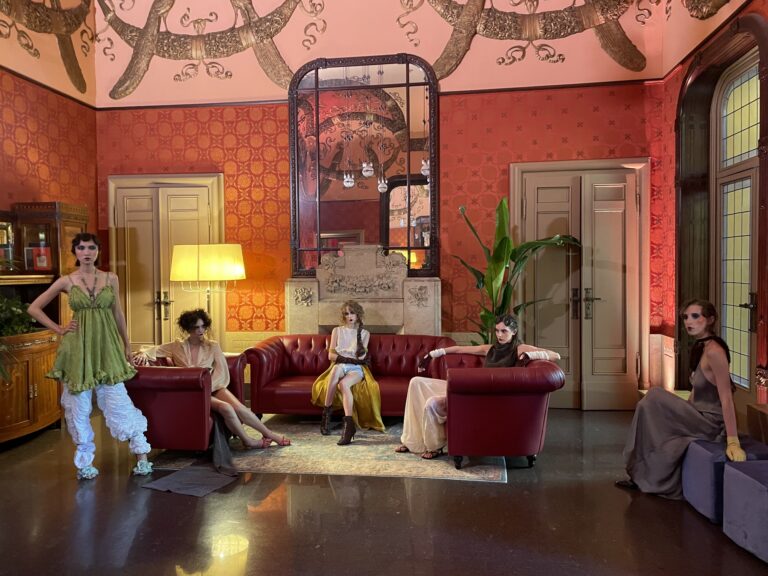
The latest edition of Milan Fashion Week featured the debut of many projects created in collaboration with schools and young designers. In particular, one of these projects involved a group of young designers from the Politecnico di Milano who set out to explore an innovative and sustainable fiber—Longcell—with the goal of introducing it to the Italian and European fashion industries.
For the occasion, the young designers created about 20 women’s looks, presenting dresses, skirts, and blouses with an elegant, silky, and fluid appearance and an extremely soft feel. They were all made with Longcell, a special type of lyocell consisting of a continuous cellulose fiber derived from eucalyptus pulp, which was first presented in 2017 at the Shanghai Expo Yarn.
The fiber is produced by Zhejiang Huafeng Longcell Fiber Technology Co., Ltd., a Chinese company based in Anji—a city in China’s Zhejiang province—founded in 2020. The company has received ISO 9001, ISO 45001, and FSC certifications, while the fiber itself has earned sustainability certifications from OEKO-TEX STANDARD 100 and Testex Swiss.
The company has an annual production capacity of over 2,000 metric tons and has conducted extensive research over the years to improve the fiber’s quality and environmental impact, securing more than 30 patents.
Lyocell, in fact, uses a closed-loop production method, employs biodegradable substances, and has low water consumption; for this reason, its production process has a low environmental impact. Furthermore, discarded garments do not cause harm when disposed of but can be used, for example, as fertilizer without releasing harmful substances.
Lyocell continuous filament also boasts high-quality characteristics because, unlike Tencel, for example, it consists of a long fiber that ensures a soft and smooth feel. It does not pill and stands out for the brilliance and durability of its colors, as well as its remarkable ability to retain its shape even after numerous washes in hot water. Furthermore, the fiber’s remarkable strength ensures the garments’ durability without compromising their comfort and breathability.
The fiber is already being used by some companies in the fashion and sportswear sectors in Turkey, China, and, more recently, Italy—a market through which it aims to gain recognition in the rest of Europe.