

The new free trade agreement between India and Europe, an internal market increasingly focused on brands and trends, and a long-standing tradition and expertise in apparel and textiles. All this suggests that India’s future is already mapped out. However, there are still some unresolved issues that could slow down the transformation of this giant.
After long negotiations started in 2022, the European Union and India have reached a Free Trade Agreement signed on 27 January 2026.
The newly achieved step grants access for EU exports to the world’s most populous country with its 1.45 billion inhabitants, it will (hopefully) boost EU exports to India and gradually eliminate or reduce tariffs on over 96% of EU goods exports. Most duties will be canceled despite not all of them and not immediately, but the change can bring a significant evolution for both parts. (Source: EU Commission)
The European Union is India’s largest trading partner, accounting for €120 billion worth of trade in goods in 2024 or 11.5% of total Indian trade. India is the EU’s 9th largest trading partner, accounting for 2.4% of the EU’s total trade in goods in 2024. Trade in services between the EU and India reached €59.7 billion in 2023, up from €30.4 billion in 2020. (Source: EU Commission)
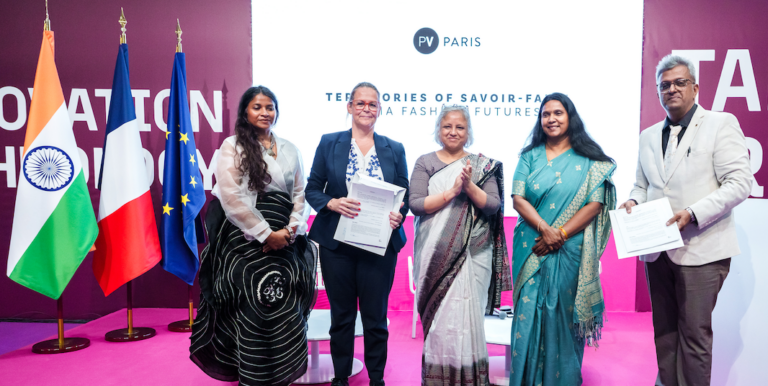
Premiere Vision, the French textile trade show, for instance, has recently announced the signing of an agreement with the Indian Government that will lead to a reciprocal collaboration between the two countries’ textile industry. EU and Indian companies will be supported in tighter commercial collaborations and will be able to participate in their reciprocal shows.
“The signing of the free trade agreement between the European Union and India in January 2026 gives a collaboration started in 17th century a concrete rapprochement. Trade in goods and services between the EU and India already totals more than €180 billion per year and supports nearly 800,000 jobs within the EU,” commented Florence Rousson, general director, Division Mode GL Events/Première Vision.
Raw materials, an excellence for India
According to industry studies, India is the world’s second-largest cotton producer after China, whose annual production in the 2025–2026 period accounts for 29% of global production. India, instead, accounts for 19.5% of the world’s total (Source: U.S. Department of Agriculture/USDA).
However, although it is not the leading producer by volume, India remains the country with the largest area under cotton cultivation, accounting for 38% of the global total—its yield per hectare is, however, lower than China’s. (Source: Just Style, 2026)
Conversely, India is the world’s largest producer of jute (Press Information Bureau-PIB, 2026), as well as one of the world’s leading producers of polyester, silk, and fibers. Furthermore, it is home to many globally active textile industries. The abundant availability of raw materials such as cotton, wool, silk, jute, and man-made fibers has, in fact, made India one of the world’s leading producers of textiles and apparel.
In terms of raw materials, the country offers a full range of cotton qualities, from “middling” fibers suitable for medium-count yarns to Suvin cotton, which can be used for finer count products. This is complemented by a strong capacity in synthetic and cellulosic fibers, with groups such as Birla—a producer of cellulose fibers—and Reliance Industries—a major producer of synthetic fibers—ranking among the sector’s leading global players.
When it comes to denim, in particular, companies have bettered the quality level of the product they offer in recent times. Among the leading players in this segment are, for example, global companies such as Arvind Limited and UCO Raymond.
